
Is Your Heat Pump Too Loud? Causes and Fixes in Port Moody
A healthy heat pump hums — it doesn't bang, rattle, or scream. If your outdoor unit is keeping you (or your neighbours) up at night, here's how to read what it's telling you and what to do about it.

Free in-home assessment · Upfront pricing · Rebate paperwork handled
Published 2026-10-05 · Airmount Mechanical
A quiet heat pump hums. Everything else is a symptom.
A modern heat pump's outdoor unit should sound like a quiet conversation or a running dishwasher — a steady, even hum in the background. Rattling, banging, grinding, screeching, or a new buzzing that wasn't there last season is your unit telling you something changed: a loose part, a failing bearing, ice where it shouldn't be, or an installation detail (like mounting or placement) that was never quite right. The good news: most heat pump noise has a fix, and many are cheap.
Tight lots, close neighbours.
In Port Moody, the outdoor unit often sits metres from a bedroom window, a neighbour's patio, or a townhouse common wall — Moody Centre duplexes, Glenayre hillside homes, and Seaview townhomes don't have the setbacks of a British Properties estate. That means noise that would vanish into a big West Vancouver lot becomes a neighbourly issue here. Placement discipline matters as much as equipment quality, and it's exactly what we plan for during the free in-home assessment.
What each noise usually means.
Different sounds point to different problems. Here's the quick decoder our technicians use on service calls.
1. Rattling or buzzing: loose panels or screws
The most common cause of new noise — and the cheapest fix. Outdoor units vibrate constantly; over months, panel screws and access covers loosen and start to buzz. A technician can tighten everything in minutes. If the rattle is recent and mild, this is the likeliest culprit.
2. Clicking or clacking: debris in the fan
Twigs, leaves, or ice buildup can contact the fan blades and produce a rhythmic clicking. Port Moody's wind off the inlet carries plenty of debris. Keep a metre of clear space around the unit and hose off the coils gently in spring and fall — never with a pressure washer.
3. Grinding or squealing: fan motor bearings
A grinding or high-pitched squeal that gets worse as the unit runs usually means the fan motor bearings are wearing out. This one needs a service visit — a failing motor left running will eventually seize, and that failure is far more expensive than the motor replacement.
4. Gurgling or hissing: refrigerant issues
Some refrigerant whoosh at startup is normal. Persistent gurgling, bubbling, or hissing points to low refrigerant from a leak — and a low-charge system also runs longer and harder, which makes it louder overall. Low refrigerant always needs a certified technician to find and fix the leak before recharging.
5. Whoosh plus steam: defrost mode
In cold, damp weather your heat pump briefly reverses to melt ice off the outdoor coil — you may hear a whoosh, see steam, and notice the fan stop. That's normal and self-resolving, as we explain in our Lower Mainland winter guide. If it's happening constantly or never finishing, though, the defrost control or sensor may need attention.
6. Deep humming indoors: vibration transfer
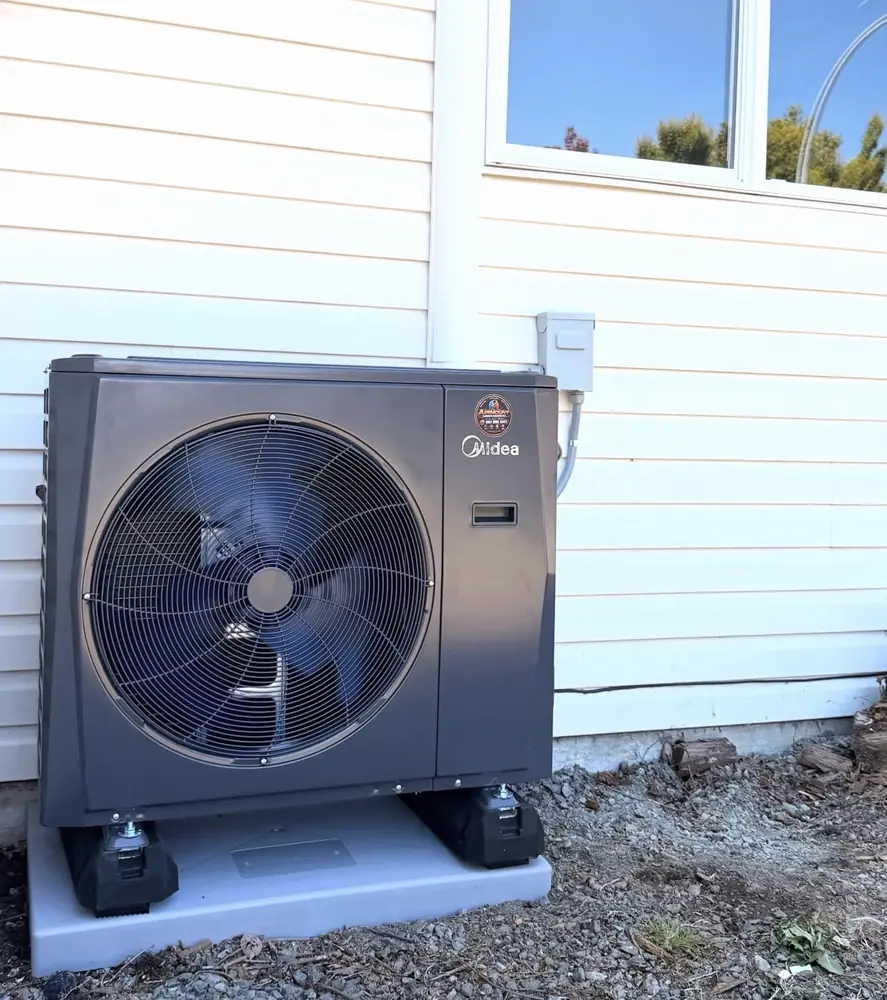
If the unit sounds fine outside but you hear a low hum inside the house — especially through bedroom or office walls — vibration is travelling through a rigid mount or a wall bracket. Anti-vibration pads or rubber isolation mounts between the unit and its pad almost always solve it.
7. Loud at startup, quiet later: short cycling or oversize
An oversized unit that slams on, roars for a few minutes, and shuts off repeatedly is worse for noise, wear, and power bills than a correctly sized one running long and quiet. Correct sizing starts with a proper heat-load calculation — which is why our installations always begin with one.
Start with the simple stuff.
Before you spend anything: clear leaves and debris, check that nothing (a garden hose, a kid's bike) is leaning against the unit, and make sure shrubs haven't grown into the fan zone. If the noise is a rattle, ask a tech to tighten the panels at your next service — it's often part of routine maintenance.
For vibration hum, anti-vibration pads under the unit or isolation mounts on a wall bracket are inexpensive and dramatically effective. A fitted compressor sound blanket knocks down the compressor's own tone — but it must be rated for your model so airflow and cooling aren't restricted. Never wrap a unit in improvised insulation; restricting airflow creates new problems, including freeze-ups like the ones in our Coquitlam freezing guide.
Where you put it decides how loud it feels.
A surprising share of "loud heat pump" complaints we see are actually placement complaints: a unit mounted on the bedroom wall of the house, tucked into a corner that bounces sound back at the patio, or aimed at the neighbour's fence. Sound reflecting off a hard surface can feel twice as loud as the same unit in open space.
Smart placement means: away from bedroom and office walls where possible, never in a walled box that traps sound (units need airflow clearance on all sides), and with a privacy screen or fence set far enough back to break the sound path without choking the airflow. On tight Port Moody lots, an extra few metres of refrigerant line run — planned at installation — often buys a noticeably quieter result. If your existing unit is badly placed, relocation is a real option, and it's much simpler than most homeowners expect.
Don't let a $50 part become a bylaw fight.
Municipalities around Metro Vancouver set daytime and nighttime noise limits, and a failing bearing can push an otherwise compliant unit over the line. If a neighbour raises it, take it as free early-warning diagnostics: a service visit usually fixes the noise and the complaint together. If your unit is old enough that parts keep failing, compare the repair bill against a modern cold-climate unit — installed from $13,000, financed from $100/month, and dramatically quieter than the machines of even a decade ago.
Three noises that shouldn't wait.
Grinding or squealing from the fan motor, persistent hissing or bubbling that suggests a refrigerant leak, and any loud bang on startup — get a technician out promptly for those. Everything else can usually wait for a scheduled service, but don't live with a noise that's getting worse; failing parts are always cheaper to replace early. Call (604) 999-4441 or email Info@airmountmechanical.com and we'll get your heat pump humming quietly again — most noise service visits are resolved in a single trip.
Common questions
What is a normal noise level for a heat pump?
A healthy heat pump's outdoor unit produces a steady, even hum — roughly like a running dishwasher. Occasional brief sounds are normal too: a whoosh and some steam during defrost cycles in cold weather, and a short surge at startup. Rattling, banging, grinding, or screeching are not normal and point to something that needs attention.
Why is my heat pump suddenly louder than usual?
The most common causes are loose panels or screws (a new rattle), debris or ice contacting the fan blades (clicking), worn fan motor bearings (grinding or squealing), low refrigerant from a leak (gurgling or hissing plus longer run times), or vibration transferring through a rigid mount into the house. A quick service visit can pinpoint it in one trip.
How can I make my heat pump quieter?
Start with maintenance: clear debris, keep a metre of clear space, and have panels tightened. For vibration hum, anti-vibration pads or isolation mounts work well. A fitted, model-rated compressor sound blanket reduces compressor tone. For persistent problems, check placement — relocating the unit away from bedroom walls or reflective surfaces often makes the biggest difference.
Can I put a fence or cover around a noisy heat pump?
Yes, but with care: screens and fences must sit well back from the unit so airflow stays unrestricted on all sides, or you'll trade noise for poor performance and freeze-ups. Never enclose a unit in a tight box or wrap it in improvised insulation — that chokes airflow and can void warranties. Ask a technician what clearance your model needs.
My heat pump is loud during defrost — is that normal?
Yes, brief defrost noise is normal: the unit reverses to melt ice off the outdoor coil, which can produce a whoosh, steam, and a stopped fan for several minutes. If defrost cycles run constantly, never finish, or are accompanied by heavy icing, the defrost sensor or control board may need servicing.
When should I replace a noisy heat pump instead of repairing it?
Consider replacement when the compressor itself is failing, repairs keep recurring, or the unit is oversized and short-cycling — a sizing problem repairs can't fix. Modern cold-climate units are dramatically quieter than older models, install from $13,000 with financing from $100/month, and up to $21,500 in combined BC rebates may apply when switching off fossil-fuel heat. We'll confirm your eligibility before you commit.
Get an exact price for your home.
Call (604) 999-4441 or book a free in-home assessment. We'll measure, calculate your heat load, and quote one fixed price — no guesswork.
Or email us at Info@airmountmechanical.com
Related reading
Heat pump installation
Cold-climate heat pumps installed in a day — from $13,000, with up to $21,500 in BC rebates.
Heat pump installation in West Vancouver →Heat pump freezing up
Why your heat pump is freezing up — and the airflow mistakes that cause it.
Why Your Heat Pump Is Freezing Up (Coquitlam Guide) →All articles
Heating, cooling, and hot water advice for Lower Mainland homeowners.
The Airmount blog →