
Furnace Filters 101: Sizes, MERV Ratings and Change Schedules for Port Moody Homes (2026)
The cheapest part of your heating system does the most quiet damage when it is wrong. Here is how Port Moody homeowners find their exact furnace filter size, choose a MERV rating their blower can actually handle, and set a change schedule based on the filter in the slot — not a generic calendar reminder.
Free in-home assessment · Upfront pricing · Help with rebate paperwork
Published 2026-11-16 · Airmount Mechanical
Your filter size is already printed in your home — you just have to read it in the right order.
Every furnace filter argument starts the same way: a homeowner in a Port Moody hardware aisle, phone in hand, trying to remember whether the number at home was 16 by 25 or 20 by 25. Guessing is how the wrong filter ends up bent into a slot, leaking unfiltered air around its edges for a whole heating season. The size is three numbers — length by width by thickness, in inches — and the system you already own will tell you all three if you look in the right places. A filter that fits snugly, with no gaps and no forcing, protects both your indoor air and the blower that has to pull air through it. A filter that is even slightly wrong does neither job properly, however expensive it was.
Five checks that settle size, direction and location for good.
Do these once, write the result on the furnace itself with a marker, and you will never stand in that aisle guessing again.
1. Read the frame of the filter already installed
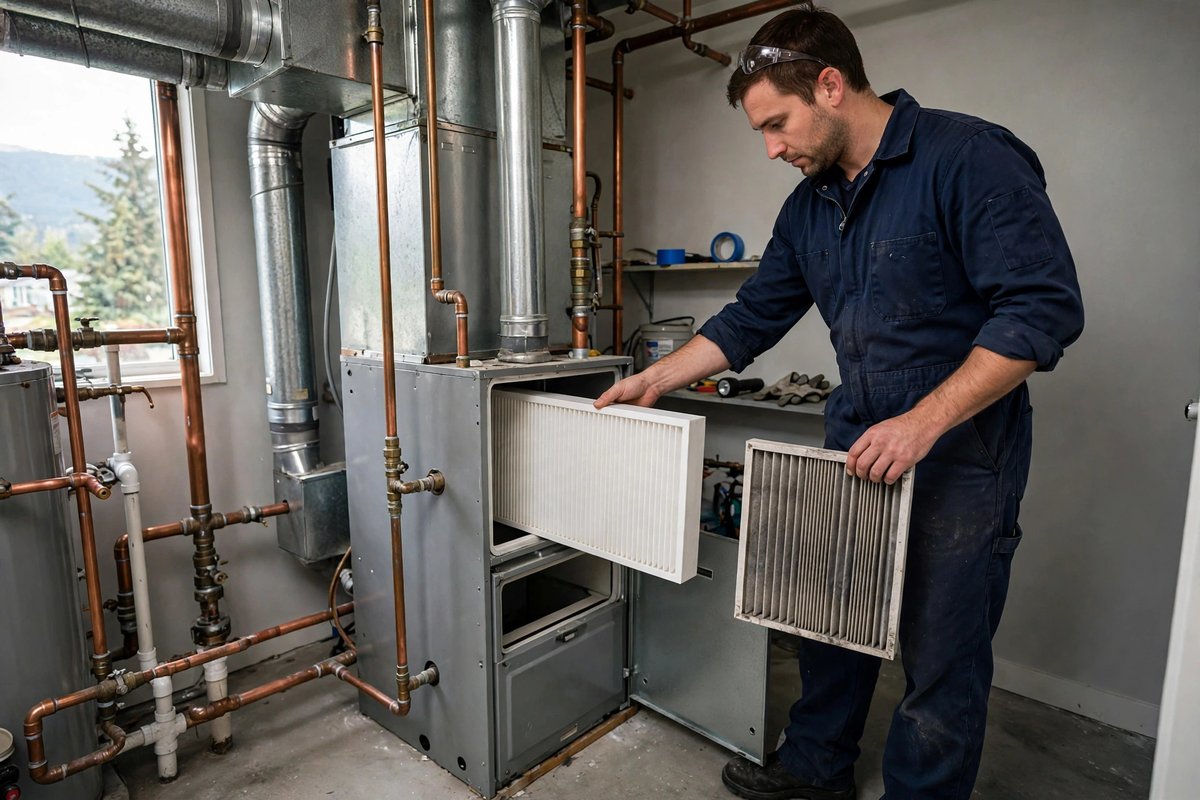
Slide the current filter out and read the numbers printed on its cardboard frame — something like 16x25x1 or 20x25x4. That is length by width by thickness, and if the old filter sat flat and snug, it is the size to reorder. No filter installed at all? Measure the inside of the empty slot itself, in all three dimensions, and write those numbers down instead.
2. Know nominal size from actual size
The number on the box is the nominal size, rounded for the shelf. The actual filter is deliberately a fraction of an inch smaller so it slides in and out without tearing. That small difference is normal and is not a defect — but it is why you buy by the printed nominal size, not by a tape measure held against the old filter's crumpled frame.
3. Follow the airflow arrow, every time
Every disposable filter has an arrow printed on its frame. It must point toward the furnace blower — in the direction the air travels — and away from the return duct bringing air back from the house. A filter installed backwards presents its unsupported side to the airflow, can bow or collapse under pressure, and filters poorly from its first day.
4. Check both places a filter can live
Most Port Moody furnaces and heat pump air handlers hold the filter in a slot beside or below the blower. Some homes — including many older houses around Moody Centre and Glenayre — filter instead behind a large return-air grille in a hallway wall or ceiling. If the furnace slot is empty, do not add a second filter at the grille system as well: two filters in series choke airflow. One location, one filter.
5. Never run the system with no filter to 'help airflow'
It is tempting during a cold snap, and it is a false economy. Without a filter, dust coats the blower wheel and the indoor coil, efficiency falls, and the dirt you saved the filter from catching ends up in the most expensive parts of the system to clean. If the correct size is not on hand, run the old filter a few more days rather than none at all.
Higher captures more — until it starts starving the blower.
MERV — Minimum Efficiency Reporting Value — rates how small a particle a filter can capture. Low ratings catch lint and large dust. The middle of the range, roughly MERV 8 to 11 in a pleated filter, is the working sweet spot for most homes: it captures household dust, pollen and pet dander while letting air move freely. Higher ratings capture finer particles, which helps some allergy households, but the denser media also resists airflow — and a residential blower that was never sized for that resistance works harder, moves less air, and can overheat the furnace or freeze a cooling coil. Before stepping above the rating your system came with, check the furnace manual for a stated maximum, or ask at your next service. Filtration is only one layer of cleaner air; our guide to indoor air quality upgrades that actually work covers what helps beyond the filter slot.
The schedule depends on thickness first, household second.
Thin 1-inch filters have little surface area, so they load up fast: check one monthly and expect to replace it every one to three months during the heating season. Thick 4- or 5-inch media filters hold far more dust in their deep pleats and commonly run six to twelve months. Then adjust for your house. Shorten the interval if you have shedding pets, a wood-burning fireplace, recent renovation dust, or a home in the trees around Heritage Mountain where pollen and summer wildfire smoke settle heavily — Port Moody's damp Inlet winters also mean systems run long hours, cycling more air through the filter each week. The reliable test costs nothing: hold the filter up to a light. If you can barely see light through it, its schedule is over, whatever the calendar says.
A dirty filter imitates expensive failures — check it before you fear the worst.
A loaded filter restricts airflow, and restricted airflow presents as real faults: weak heat at the registers, rooms that never catch up, a furnace that runs, stops and restarts in short bursts as it overheats, or a system that blows lukewarm air. Our guide to why furnaces short cycle puts a clogged filter first on its list for exactly this reason — it is the cheapest cause and the most common. Before booking a repair for any of those symptoms, pull the filter and look at it. If a fresh, correctly sized filter restores normal running, you have found the fault for the price of a filter. If symptoms persist with a clean filter in place, that is genuine diagnostic information worth handing to a technician, not a failed experiment.
Right size, sensible MERV, changed on its own schedule.
Furnace filters reward three small habits: buy the exact size printed on the old frame, choose a MERV rating in the range your blower was built for, and check monthly so the household — not a generic reminder — sets the change date. When a system is due for replacement, filter access and media size are part of a proper quote; see our furnace replacement page for what that includes. Airmount Mechanical serves Port Moody and the whole Lower Mainland from 2175 Lawson Ave, West Vancouver, BC. Call (604) 999-4441 or email Info@airmountmechanical.com for a free in-home assessment — and if you are unsure which filter your system should run, bring the old one to show us. Browse all our articles for more heating guides.
Common questions
How do I find my furnace filter size?
Slide out the filter currently installed and read the three numbers printed on its cardboard frame, such as 16x25x1 — that is length by width by thickness in inches, and it is the size to reorder if the old filter sat flat and snug. If no filter is installed, measure the inside of the empty slot in all three dimensions instead. The size on the box is the nominal size; the actual filter is made slightly smaller so it slides in easily.
How often should I change a 1-inch furnace filter?
Check it every month and expect to replace it every one to three months during the heating season. Homes with shedding pets, a wood-burning fireplace, recent renovation dust or heavy pollen and wildfire smoke will be at the short end of that range. The simplest test is to hold the filter up to a light — if you can barely see light through it, it is done, regardless of how long it has been in.
How often do thick 4-inch or 5-inch media filters need changing?
Far less often than thin filters. Their deep pleats hold much more dust, so a 4- or 5-inch media filter commonly lasts six to twelve months in a typical home. Check it at the start and middle of the heating season rather than monthly, and replace it when it looks uniformly grey and light no longer passes through the pleats easily.
What MERV rating should a Port Moody home use?
For most homes, a pleated filter around MERV 8 to 11 is the working balance: it captures household dust, pollen and pet dander without unduly restricting airflow. Higher ratings capture finer particles but resist airflow more, and a blower not sized for that resistance can overheat a furnace or freeze a cooling coil. Check your furnace manual for a stated maximum MERV before stepping up, or ask during a service visit.
Which way should the arrow on my furnace filter point?
Toward the furnace blower — in the direction air travels through the system — and away from the return duct bringing air back from the house. A filter installed backwards presents its unsupported side to the airflow, can bow under pressure, and filters poorly. The arrow is printed on the filter's frame; check it every time, even if you have changed the same filter many times before.
Can a dirty filter really make my furnace short cycle or blow cold air?
Yes. A clogged filter restricts airflow, so the furnace overheats and its safety limit shuts the burner off, then restarts it once it cools — the short on-off pattern homeowners notice — and registers can blow lukewarm air in between. It is the cheapest and most common cause of those symptoms, so always check the filter first. If the problem persists with a clean, correctly sized filter installed, book a diagnosis and tell the technician what you already ruled out.
Get an exact price for your home.
Call (604) 999-4441 or book a free in-home assessment. We'll measure, calculate your heat load, and quote one fixed price — no guesswork.
Or email us at Info@airmountmechanical.com
Related reading
Why your furnace keeps short cycling
A clogged filter is the first cause on the list — here is the full diagnosis order, cheapest checks first.
Read the short-cycling guide →Furnace replacement
High-efficiency furnaces with proper media filtration, quoted as one upfront fixed price after a heat-load calculation.
Furnace replacement in West Vancouver →All articles
Heating, cooling, hot water and rebate advice for Lower Mainland homeowners.
The Airmount blog →