
Boiler Pressure Keeps Dropping in Delta? What to Check When It's Too High or Too Low (2026)
A boiler pressure gauge that will not stay put is telling you something — water is leaving, air is getting in, or the expansion side is struggling. For Delta homeowners, here are the safe checks to do first, what too high and too low really mean, and where to stop and call.
Free in-home assessment · Upfront pricing · Help with rebate paperwork
Published 2026-11-14 · Airmount Mechanical
A sealed system should hold its pressure — not need constant topping up.
Most Delta homes with a boiler heat through a sealed loop: the same water circulates through radiators, baseboards or in-floor piping, expands as it heats, and contracts as it cools. That is why the gauge moves a little — higher hot, lower cold. What matters is the cold reading, taken before the heating runs in the morning. For many systems that cold reading sits around 1 to 1.5 bar, but your boiler manual and the height of your home set the exact figure — a two-storey North Delta house needs enough pressure to keep its top-floor radiators full, while a Ladner rancher needs less. A single top-up once or twice a heating season can be normal. Topping up every week, or watching the needle fall day after day, is not. Water is going somewhere, and repeatedly adding fresh water dilutes system treatment and invites corrosion.
Five checks you can do without opening the boiler.
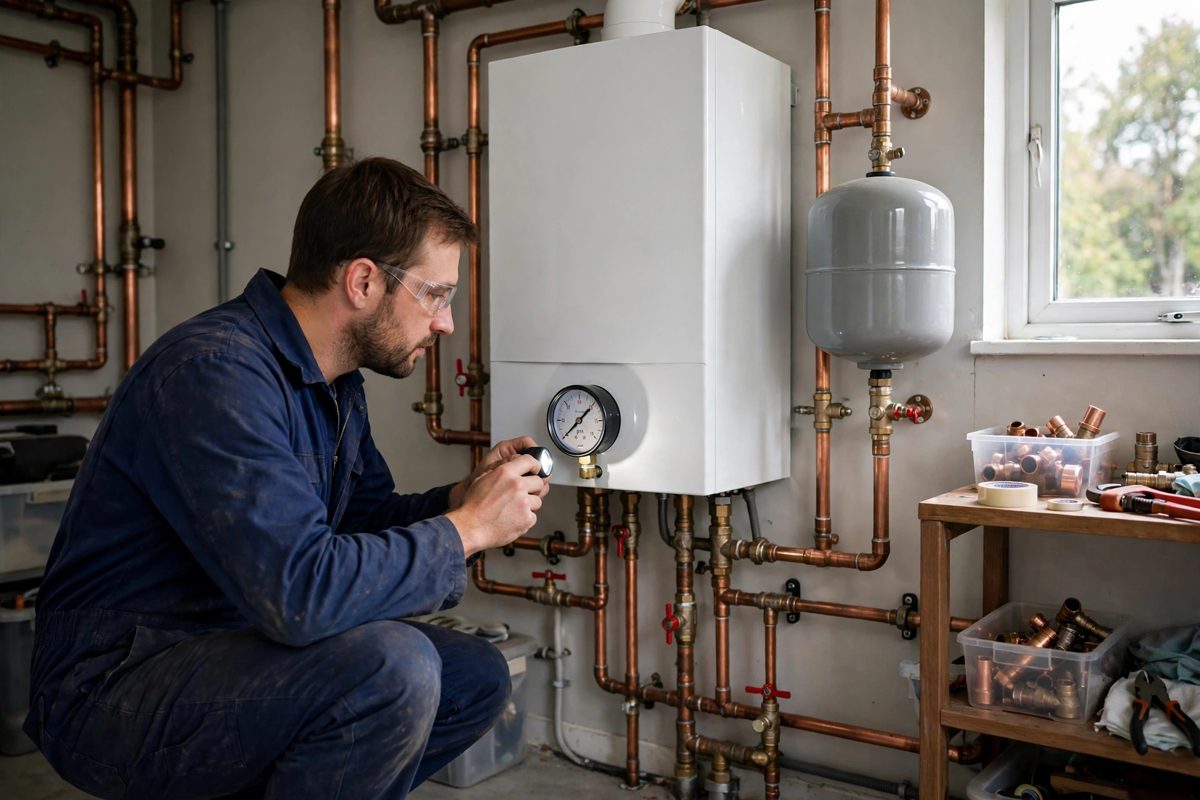
Keep every check visual and outside the casing. Photograph the gauge cold, keep a short log for a few days, and work through these in order — the pattern you find points to the cause far better than a single reading does.
1. Log the cold pressure for three mornings
Read the gauge at the same time each morning while the system is cold and write the number down. A slow, steady fall suggests a small leak somewhere in the loop. A reading that is normal cold but climbs sharply whenever the heating runs, then falls again, points instead toward the expansion vessel — the tank that is supposed to absorb that growth in volume. That hot-versus-cold pattern is the single most useful thing you can tell a technician before they arrive.
2. Hunt for weeping joints with a dry tissue
Small leaks rarely drip. On warm pipes the water evaporates before it can pool, leaving only a faint rusty streak, white mineral crust, or damp patch below a joint. Wipe a dry tissue around every radiator valve, the nuts at each end of each radiator, baseboard connections, and the pipes directly under the boiler, then look for a damp mark. Check under the boiler and in the crawl space too — a weep hidden under a floor in an older Ladner or Tsawwassen home can run for weeks before it shows.
3. Check the discharge pipe outside
Find the thin pipe that exits the wall near the boiler and turns down outside — that is the outlet for the pressure relief valve, the safety device that lets water out if pressure gets too high. If its end is wet or dripping, the valve has been opening — usually because pressure is spiking when the system heats, most often from an expansion vessel that has lost its air cushion, or a worn valve that no longer seats cleanly. Never cap, block or bend that pipe closed: it is a safety outlet, not a nuisance leak to silence.
4. Remember what bleeding radiators does
If you recently bled air from radiators, a pressure drop afterwards is expected — you let a little water out with the air. Top up once, with the system cold, to the figure your manual specifies, and then watch it. If it holds for weeks, that was all it was. If it falls again within days without any bleeding, the cause is elsewhere and more topping up will only mask it. Our guide to how hydronic heating works explains why air, pressure and circulation are so closely linked in these systems.
5. Notice the company the pressure problem keeps
Pressure faults rarely travel alone. Radiators that are hot at the bottom and cold at the top, gurgling or banging as the system runs, a boiler that locks out on cold mornings, or one room that never quite warms up all add context. If noises are part of it, compare them with our boiler noises guide — noting kettling, banging or gurgling helps narrow the diagnosis. Write symptoms down with your log.
Why pressure that climbs too high matters just as much.
Homeowners understandably focus on pressure that is too low, because that is what stops the heat. Pressure that rises too far on every heating cycle is equally telling. Water has to expand somewhere; if the expansion vessel is flat or undersized, pressure spikes until the relief valve lifts and dumps water outside — which is exactly why that system then reads low the next morning. Fixing only the low reading, by topping up again and again, leaves the real fault untouched. A technician will check the vessel charge and size, test the relief valve, and confirm the filling loop is fully closed — a filling valve left slightly open can also feed pressure in slowly. None of that is homeowner work; it belongs behind the casing until a professional opens it.
The same gauge, three different houses.
In an older Ladner Village home, the culprit is often a valve stem that weeps only when hot — dry at breakfast, damp by dinner. In a taller North Delta home, pressure set too low for the height leaves upstairs radiators half-full and noisy. In Tsawwassen, salt air corrodes outdoor pipework and fittings, so a joint can be the quiet source. The checks above sort most of these. If the diagnosis is an ageing boiler at the end of its life rather than a repairable fault, weigh the numbers in our boiler replacement cost guide before deciding — a proper replacement quote should follow a heat-load calculation, not a guess, and come as one upfront fixed price.
Call rather than top up when you see these signs.
Stop and book service if you are topping up more than a couple of times in a season, if the discharge pipe drips regularly, if pressure swings wildly between hot and cold, if you can smell gas or see scorching or water inside the boiler casing, or if the boiler keeps locking out. Do not remove the casing, adjust the expansion vessel charge, operate the relief valve as a test, or leave a filling loop open unattended. Those are the lines between a safe homeowner check and gas and pressure work that belongs to a technician.
Read it cold, log it, and fix the cause — not the needle.
Boiler pressure problems in Delta almost always have a findable cause: a weeping joint, a relief valve doing its job because the expansion vessel cannot, or a setting never quite right for the house. Airmount Mechanical handles boiler and hydronic service from 2175 Lawson Ave, West Vancouver, BC, serving the whole Lower Mainland. Call (604) 999-4441 or email Info@airmountmechanical.com for a free in-home assessment — bring your three-day pressure log, and we will trace the loss or the spike, explain the fix in plain language, and quote one upfront fixed price before any work starts. See all our articles for more guides.
Common questions
What should boiler pressure be when the system is cold?
For many sealed systems the cold reading sits around 1 to 1.5 bar, but there is no single correct number for every home. Your boiler manual gives the figure for your installation, and the height of the house matters — a two-storey home needs enough pressure to keep its highest radiators full. Always judge the gauge cold, first thing in the morning, rather than while the heating is running and the water has expanded.
Why does my boiler pressure keep dropping after I top it up?
Pressure that falls again within days means water is still leaving the loop. The usual routes are a weeping radiator valve or pipe joint, water discharged outside through the pressure relief valve because pressure spiked while hot, or a hidden leak under a floor. Topping up restores the reading temporarily but does not fix any of those — if you are refilling every week, the leak or the expansion fault needs finding.
Why does boiler pressure go too high when the heating is on?
Water expands as it heats, and the expansion vessel is meant to absorb that growth. If the vessel has lost its air charge or is too small for the system, pressure climbs sharply on each cycle until the relief valve opens and lets water out — which is why that same system often reads too low again once cold. A filling valve left slightly open can also push pressure up slowly. Both causes need a technician to check behind the casing.
Is it safe to keep topping up a boiler that loses pressure?
An occasional top-up, once or twice a heating season, is normal. Doing it repeatedly is not a fix and can cause harm: every refill brings in fresh, untreated water that dilutes corrosion inhibitor and can accelerate rust inside radiators and the boiler. If you are topping up monthly or more, stop treating the gauge and book a diagnosis for the underlying leak or expansion problem instead.
What does it mean if the pipe outside my boiler is dripping?
That pipe is the discharge outlet for the pressure relief valve, a safety device that releases water when pressure exceeds its set point. A wet or dripping end means the valve has been opening — most often because pressure is spiking when the system heats, typically from a failed expansion vessel, or because the valve itself no longer seals. Never cap or block that pipe; it is a safety outlet and the dripping is a warning to have the cause checked.
When should a Delta homeowner call a technician about boiler pressure?
Call if pressure drops again within days of topping up, if you refill more than a couple of times a season, if the outside discharge pipe drips regularly, if upstairs radiators stay cold or noisy, or if the boiler locks out repeatedly. Call straight away and do not open the casing if you smell gas, see water or scorching inside the boiler, or cannot get any heat. Airmount Mechanical offers a free in-home assessment — call (604) 999-4441.
Get an exact price for your home.
Call (604) 999-4441 or book a free in-home assessment. We'll measure, calculate your heat load, and quote one fixed price — no guesswork.
Or email us at Info@airmountmechanical.com
Related reading
Boiler replacement cost in Vancouver
What a boiler replacement actually costs, what drives the quote, and when repair stops making sense.
Read the cost guide →Hydronic heating explained
How boiler, radiator and in-floor systems circulate heat — and why pressure and air matter so much in them.
Read the hydronic guide →All articles
Heating, cooling, hot water and rebate advice for Lower Mainland homeowners.
The Airmount blog →