
Radiant Floor Heating Cost in North Vancouver: What New Builds and Retrofits Pay Differently (2026)
Radiant floors are the comfort everyone wants — and the quote nobody can price from a square-foot guess. Here is what actually drives radiant floor heating cost in North Vancouver, and why new builds and retrofits pay so differently.
Free in-home assessment · Upfront pricing · Rebate paperwork handled
Published 2026-11-05 · Airmount Mechanical
The same warm floor can cost very differently in a new build and a retrofit.
Radiant floor heating is the comfort upgrade North Vancouver homeowners ask about most wistfully: no cold tile in January, no noisy fan kicking on, even warmth rising from the floor itself. Then comes the question — what does radiant floor heating cost? The honest answer is that there is no single per-room price we can responsibly print, because the floor assembly is only part of the job. Whether the system is electric or hydronic, whether it goes in while a floor is already open or under a finished floor you love, what heats the water or powers the mats, and how many zones you want all move the total — often more than the tubing or mats themselves. That is why we start with a free in-home assessment and a proper heat-load calculation, and quote one upfront fixed price before work begins. Below is what actually drives that price in North Vancouver homes, and why timing a radiant project with a renovation is the single biggest money decision in it.
Electric for single rooms, hydronic for whole floors.
Most of the cost confusion comes from comparing two different technologies as if they were one product.
1. Electric mats and cables
Thin heating mats or loose cables sit directly under tile or stone and run off your electrical panel, with their own thermostat and floor sensor. There is no boiler, no pump, and no manifold, so the equipment side is comparatively simple — which is why electric is usually the sensible choice for one bathroom, a kitchen, or an entryway in an Edgemont or Upper Lonsdale home that already has good heat everywhere else. Running cost follows how many hours that one room runs, so zoning it to mornings and evenings matters.
2. Hydronic tubing and a heat source
Hydronic radiant runs warm water through tubing loops under the floor, fed from a manifold and heated by a boiler, a combi unit, or a hydronic heat pump. The floor work is only part of the quote: the heat source, pumps, controls, and zone valves belong in it too. Hydronic makes its case over larger areas — a whole main floor, a Lynn Valley basement, or a new build — where one efficient heat source can feed several zones at the low water temperatures radiant floors prefer. Our guide to hydronic heating explained covers how that water-based heat feels and distributes.
3. New build versus retrofit timing
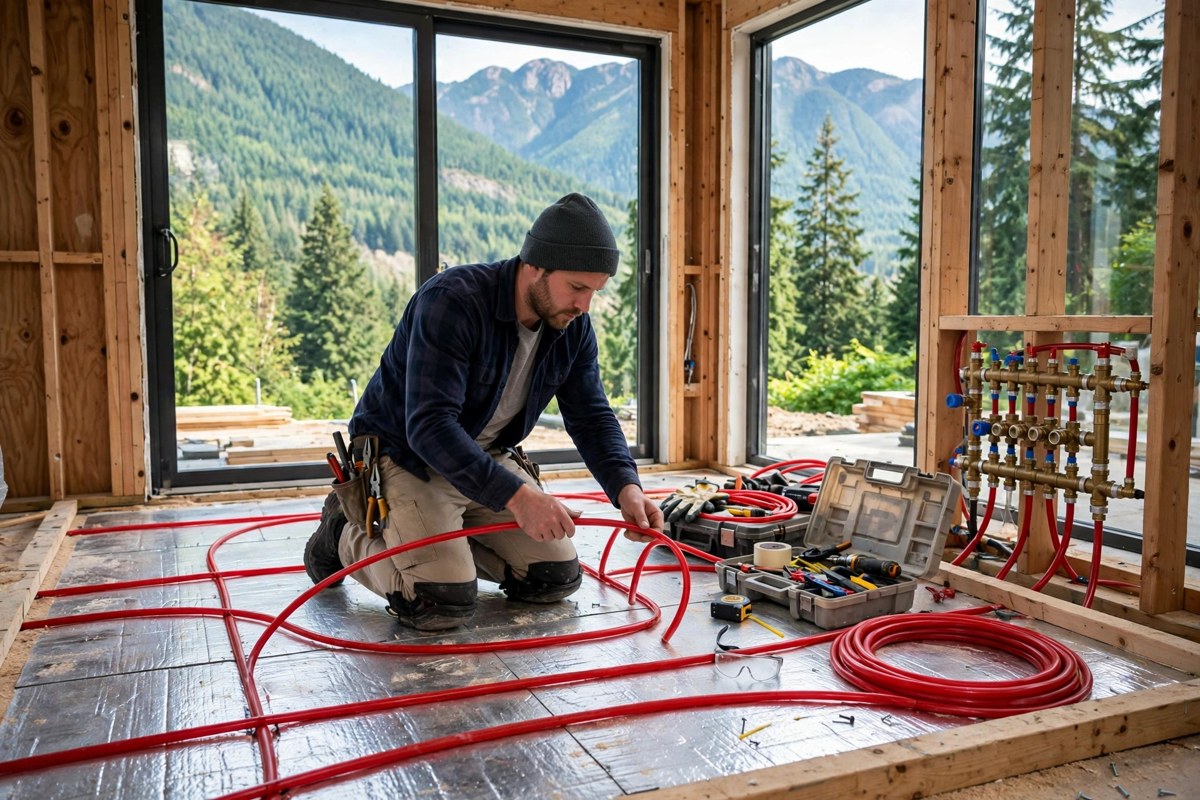
This is the biggest cost lever of all. In a new build or a renovation where the floor is already open, tubing or mats go down as one planned step before the finished floor — no demolition, no removal, no patching. Retrofitting under a finished floor you want to keep is a different job entirely: the finished surface usually has to come up, floor height and door clearances need solving, and access from below is rarely as clean as it looks. If a bathroom or basement renovation is already on your calendar, adding radiant inside that scope is almost always far cheaper than opening the same floor twice.
4. Floor area, layout and zones
Cost follows heated area, but layout matters as much as square footage. A simple rectangular basement zone is straightforward tubing work; a main floor split into a kitchen zone, a living zone, and a bathroom zone adds manifolds, valves, and thermostats — and pays you back by not heating empty rooms to keep one cold corner comfortable. Bathrooms tucked over unheated garages, sunrooms with walls of glass, and hillside homes in Capilano with big exposure differences all change the heat-load calculation, which is why we measure rather than guess from the old system.
5. Subfloor, insulation and finished floor
Radiant heat needs insulation beneath it, or part of your warmth heads down into the slab or crawl space instead of up into the room. Subfloor condition, levelling, and the finished floor itself all belong in an honest scope: tile and stone conduct heat beautifully, while thick carpet with dense underlay insulates against it. None of this is exotic — it just needs to be priced at the start, alongside any electrical work for electric systems or panel capacity the project needs, not discovered mid-job.
6. Controls that keep running costs down
A radiant floor holds heat in the floor mass, so it rewards steady, planned control rather than big temperature swings. Programmable or smart thermostats per zone, set to warm the bathroom before the morning alarm and ease back overnight, are a small line item that decides whether the comfort stays affordable. We set the controls up with you and walk through the schedule before we leave, so the system runs the way it was priced to run.
Already planning a boiler or heat pump? Price the floor at the same time.
Radiant floors run happily at lower water temperatures than old baseboards need, and that low-temperature appetite pairs naturally with modern condensing boilers and hydronic heat pumps. If your boiler is nearing replacement anyway, pricing the heat source and the floor together avoids paying twice for mechanical-room work — our breakdown of boiler replacement cost in Vancouver shows what belongs inside that quote. And if you are weighing a whole-home switch off fossil-fuel heat, a heat pump installation starts from $13,000 installed with financing from $100/month, with up to $21,500 in combined BC rebates for eligible homeowners switching off fossil-fuel heating — we'll confirm your eligibility before you commit to anything.
Comfort you feel first, in the rooms you actually use.
We will not promise a specific monthly saving, because yours depends on the system type, the area heated, how the zones are scheduled, and what heat the floor is replacing. What is fair to say is that radiant heat feels warmer at a given air temperature because the warmth is in the floor and the furnishings, not pooled at the ceiling — so many homeowners run slightly lower thermostat settings for the same comfort — and that zoning keeps you from paying to heat a guest bathroom all day for a ten-minute shower. The assessment runs the numbers for your home and your current bills, in the open, before you decide.
Ask what is inside the number — especially the floor.
When radiant quotes differ, scope is usually why. Check that each quote states electric or hydronic plainly, names the heat source or electrical work included, covers insulation and subfloor preparation, lists zones and thermostats separately, and says whether demolition and finished-floor work are in or out. A fixed, upfront price built on a measured heat-load calculation will hold up better than a square-foot guess given over the phone. Browse all our articles for more North Shore heating advice, or call Airmount Mechanical — based at 2175 Lawson Ave in West Vancouver and serving the whole Lower Mainland — at (604) 999-4441, or email Info@airmountmechanical.com, for a free in-home assessment and one fixed price for warm floors done properly.
Common questions
How much does radiant floor heating cost in North Vancouver?
There is no single fixed price, because the total depends on whether the system is electric or hydronic, the heated area and number of zones, whether a heat source or electrical work is needed, and — most of all — whether it is installed in a new build or open renovation versus retrofitted under a finished floor. We quote one upfront fixed price after a free in-home assessment and heat-load calculation, so you know the full cost before work begins.
Is electric or hydronic radiant floor heating better?
Each suits a different job. Electric mats are simpler and usually suit a single bathroom, kitchen, or entryway in a home that already heats well. Hydronic tubing fed by a boiler, combi unit, or hydronic heat pump suits whole floors, basements, and new builds, where one heat source can feed several zones at low water temperatures. We recommend based on your area and existing heating, not on a house preference.
Can radiant floor heating be retrofitted into an existing home?
Yes, but timing decides the cost. Adding radiant while a bathroom or basement floor is already open for renovation is far cheaper than lifting a finished floor you want to keep, which adds demolition, floor-height, and refinishing work. At the free assessment we look at access from above and below and tell you plainly which route your home allows.
What flooring works best over radiant heat?
Tile and stone conduct heat very well and are the classic pairing, especially in bathrooms. Many engineered wood and laminate products are also rated for radiant use within temperature limits set by their manufacturer. Thick carpet with dense underlay works against the system by insulating the room from the warm floor, so we check your planned finish before quoting.
Can radiant floors be the only heat in a North Vancouver home?
A properly designed hydronic system can heat a whole home, and many new builds use it as the primary heat. In retrofits, radiant is often added as comfort heat for key rooms while the existing system carries the rest of the house. The heat-load calculation we run at the assessment determines which role makes sense for your home's insulation and exposure.
How long does radiant floor installation take?
An electric mat in one bathroom fitted inside a renovation is a contained step in that project, while hydronic whole-floor work — tubing, manifold, heat source, and controls — is a larger, planned job. Your fixed quote sets out the expected timeline for your specific scope before we start. Space-heating heat pump installations by our own crew are often completed in a single day.
Get an exact price for your home.
Call (604) 999-4441 or book a free in-home assessment. We'll measure, calculate your heat load, and quote one fixed price — no guesswork.
Or email us at Info@airmountmechanical.com
Related reading
Hydronic heating explained
How water-based heat works, why it feels different, and which North Vancouver homes it suits.
Hydronic heating explained for North Vancouver homes →Heat pump installation
Cold-climate heat pumps installed in a day — from $13,000, with up to $21,500 in BC rebates.
Heat pump installation in West Vancouver →All articles
Heating, cooling, and hot water advice for North Vancouver and Lower Mainland homeowners.
The Airmount blog →